

Why the South Pole?
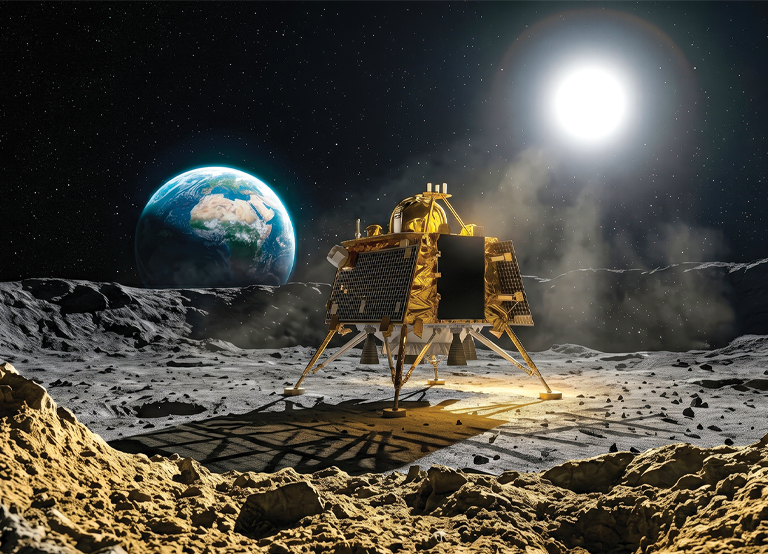
The lunar South Pole is unlike most of the moon. Some deep craters are permanently shadowed and extremely cold. Scientists believe these regions contain water ice. Water could be enormously valuable for future explorers—not just for drinking, but potentially for producing oxygen and hydrogen fuel. At the same time, some elevated areas receive sunlight for long periods, making them attractive locations for solar power.
India made history in 2023 when Chandrayaan-3 became the first mission to successfully land near the lunar South Pole. But India is no longer exploring the moon alone.
So, who owns it? The surprising answer is nobody. In 1967, countries signed the Outer Space Treaty, which says that the moon and other celestial bodies cannot be claimed as national territory. Countries cannot simply plant a flag and declare, “This belongs to us.” The treaty also says that space should remain open for exploration and use by all countries.
But this creates a fascinating problem. Imagine that one country’s rover discovers a particularly useful patch of lunar ice. Another country’s rover arrives nearby a few months later. Can both operate in the same area? What happens when several countries–and private companies–want to use the same valuable location?
The Artemis Accords, led by the United States, establish principles for peaceful and responsible exploration. India became a signatory in 2023. One interesting idea is the use of temporary “safety zones”. These are not borders or claims of ownership. Instead, they are areas around space activities where countries agree to communicate and coordinate so that one mission does not interfere with another. The zones are meant to change or disappear when the activity ends.
That, however, raises a much bigger question. If space belongs to everyone, how do we make sure its resources are used fairly? Humanity has spent centuries creating rules for sharing land, oceans and natural resources on Earth—often after conflicts had already begun. On the moon, we have a rare opportunity to do something different—write the rules before the race really begins.
Sushant Suri, CFA, FRM, CAIA, CFP is a finance educator with 20+ years of experience. He is the founder of FinGuru and has trained 20,000+ students globally for the CFA Program, with experience across leading investment firms. He is passionate about simplifying complex financial concepts and helping young readers understand money, careers and the evolving world of finance. He can be reached at [email protected]
Share