

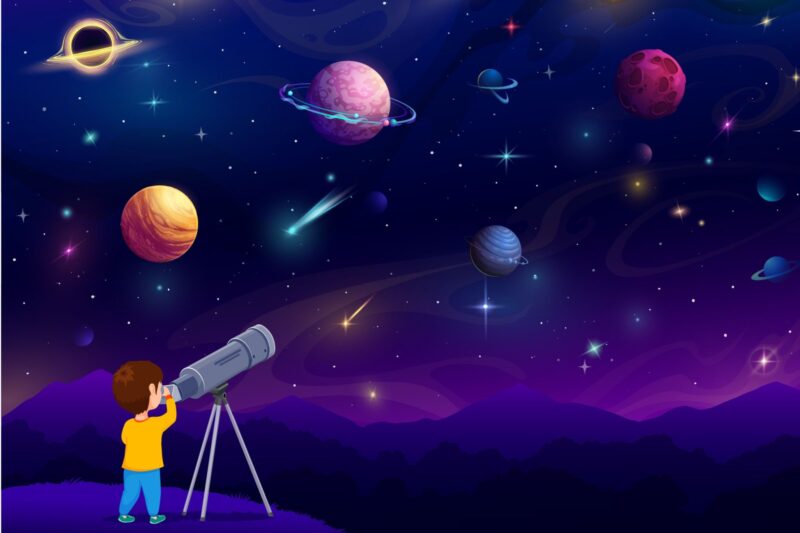
One quiet night, a fifteen-year-old boy named Arjun was watching the stars through his telescope. He loved astronomy and dreamed of becoming a scientist one day. His room was filled with books about planets, galaxies, black holes, and distant stars. Every night, he spent some time observing the sky and writing his discoveries in a notebook.
While observing the stars, Arjun noticed a strange object moving across the sky. It was glowing blue and leaving a faint trail of light behind it. At first, he thought it was a satellite, but its movement seemed unusual. He quickly recorded its position, took some photographs, and decided to observe it again the following night.
The next night, Arjun looked through his telescope and discovered that the mysterious object had moved. He compared its position with his previous observations and realised that it might be an asteroid. However, something confused him: its path appeared to curve in an unexpected way. He knew that asteroids were rocky objects that travelled around the Sun, but he could not understand what was happening.
The following morning, Arjun showed his observations to his science teacher, Mrs. Meera. She was impressed by his curiosity and encouraged him to investigate further. Together, they contacted an astronomy research centre and shared the photographs and recorded positions. Soon, a team of scientists began studying the mysterious object using powerful telescopes and computer simulations.
The scientists named the object Astra-17. Their calculations showed that it was travelling through space towards the region of Earth’s orbit. News of the discovery spread quickly, and many people became frightened. Some imagined that the asteroid would collide with Earth and destroy everything. However, the scientists explained that they needed accurate measurements before drawing any conclusions.
Arjun continued studying the asteroid’s movement. He read about gravity, orbital motion, and the forces that influence objects travelling through space. After examining the photographs carefully, he noticed that the asteroid’s path curved as it passed near another massive object. He suggested that the gravitational pull of an undiscovered celestial body might explain the unusual movement.
The scientists investigated Arjun’s suggestion and compared their observations with mathematical models. After several days of careful analysis, they discovered a small, distant celestial object whose gravitational influence explained the asteroid’s unexpected path. Arjun was amazed that a simple observation could help scientists understand something happening millions of kilometres away. He realised that mathematics was not merely a school subject; it was a powerful tool for understanding the universe.
Yet another mystery remained. Why did Astra-17 appear blue in the photographs? The scientists analysed the light reflected from its surface and discovered that its unusual appearance was related to the minerals and lighting conditions on its rocky surface. The blue colour was not evidence of anything supernatural. It was a natural phenomenon that could be investigated through scientific observation and analysis.
Meanwhile, the research team improved their calculations using the asteroid’s speed, direction, and gravitational influences. Their results showed that Astra-17 would pass Earth safely at a considerable distance. People around the world finally felt relieved. Arjun was happy that the mystery had been solved, but he also understood that scientists had to remain careful because new observations could change their understanding of an object.
The research team invited Arjun to visit their observatory. He saw enormous telescopes pointed towards distant galaxies and computers displaying images of stars, planets, and asteroids. One scientist explained that the universe was constantly changing and that many celestial objects remained undiscovered. She also told him that scientific progress depended on curiosity, patience, teamwork, and the courage to question assumptions.
During the visit, Arjun asked the scientist whether humans would ever discover everything about the universe. She replied that every discovery often led to new questions. Scientists might understand how a star forms, for example, but still investigate its life, its planets, and the mysteries surrounding it. Arjun realised that knowledge was not a destination where learning ended; it was a journey that continued with every new question.
When Arjun returned home, he looked at the night sky through his telescope once again. The stars seemed brighter, and the universe seemed larger than ever before. He opened his notebook and wrote, “The universe is full of mysteries, but fear cannot solve them. Only curiosity, evidence, and knowledge can bring us closer to the truth.” From that night onward, he continued exploring astronomy, hoping that one day he would make a discovery that could help humanity understand the cosmos.
Moral: Never be afraid to question the unknown. Use knowledge instead of fear, evidence instead of assumptions, and curiosity instead of giving up. Sometimes, one small observation can open the door to a discovery that changes our understanding of the universe.
October 2026
Share