

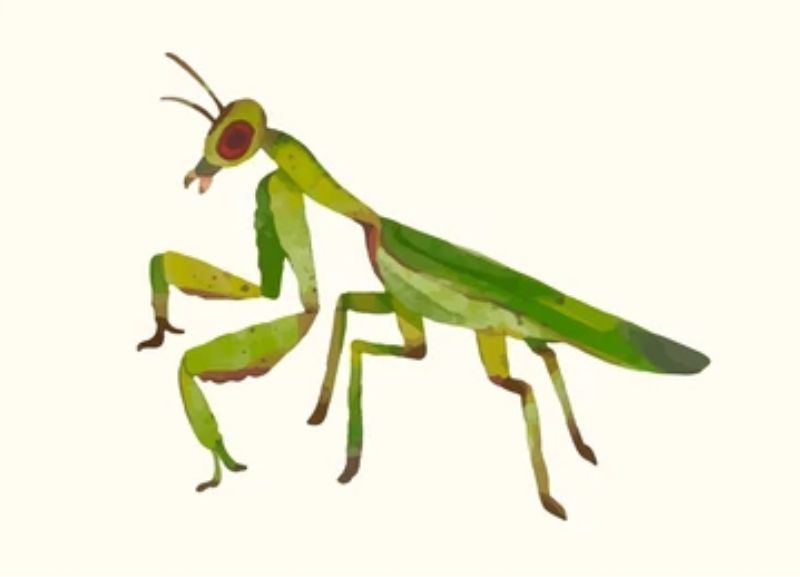
Mantids are a group of insects of which the praying mantids, called Mantis, are nature’s one of the most ruthless hunters. These insects wait patiently, perfectly camouflaged, and strike when preys come near. All mantises need to clean their serrated forearms, their primary hunting gears, as things can get stuck on them. If not groomed and cleaned to perfection, they risk their preys slipping away from their lethal grip, even if caught. They must do it after every meal.
Mating is the most dangerous part of a mantis’s life, especially if it’s a male, as females, usually bigger in size, can eat the males in order to increase egg production.
Mantids like the Giant Praying Mantis can even tackle small lizards and frogs too, but there is one thing all mantises are absolutely scared of…ants! Ants work in groups to quickly overpower the slow moving mantis and kill it.
In many cultures across the world, mantises are believed to be invincible, and they indeed are, to almost anything in real life. If you provoke a mantis, it will always defend itself.
However, ants just kill anything on their path and take no time to dismantle a mantis and shred it to pieces.
There’s a type of mantis that resembles a violin, called the Wandering Violin Mantis, but if you look closer it looks very much like a dry leaf. The mantis uses this disguise to catch its prey. This type of mantis has more barbs on their forearms than any other mantis. That is why it spends most of its time on cleaning and grooming those barbs. They are found in the moist forests of Southern India, Srilanka and Thailand.
One of the latest discoveries of a new mantis species was recently reported from Vietnam in 2025. It is commonly called Snake-Dancing Mantis because immediately after mating the male starts mimicking a unique snake-dance by swaying its abdomen sinuously like the coil of a serpent , to avoid being eaten by the female.
There are more than 2000 different species of mantis found across the world, mostly in tropical and subtropical regions. Each has adapted to its own unique habitat by developing unique morphological features to stay camouflaged in its own environment. They are the deadliest of all ambush hunters in the insect world.
Share