


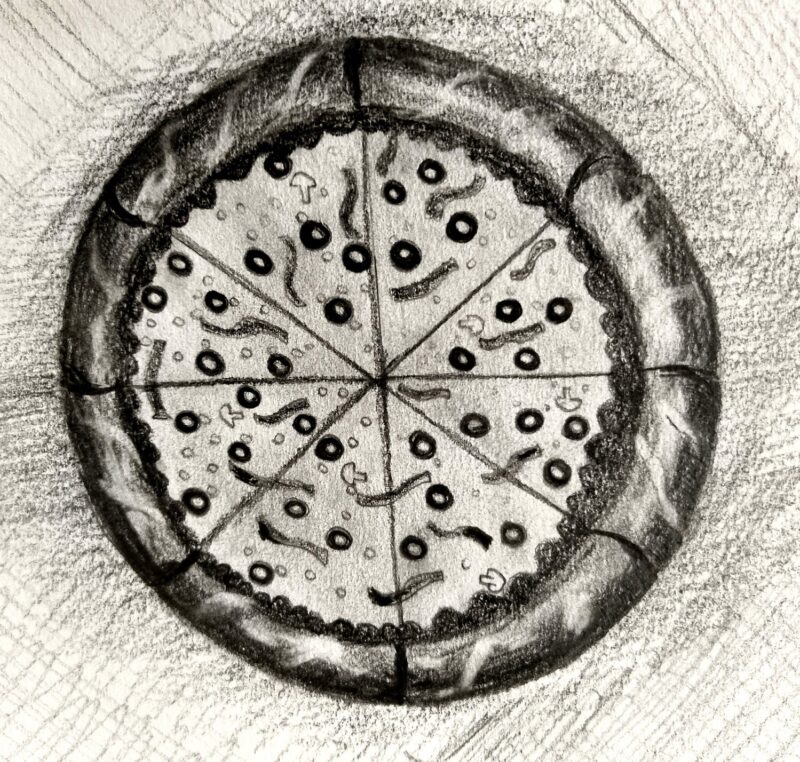
History: The first flatbreads
Have you ever wondered who and how pizza was invented? Well, Pizza was not “invented” by a single person in a single moment but evolved over a thousand of years ago from ancient flatbreads into a dish we recognize today. Its earliest precursors date back to ancient civilizations like the Egyptians, Greeks and Romans, who ate flatbreads with toppings such as herbs, onion, cheese, garlic and dates. Roman soldiers under Darius the Great started even baking flatbread with cheese and dates on their battle shields. The word “Pizza” itself was first documented much later, in 997CE in Gaeta, Italy, appearing in a legal manuscript regarding a feudal lord’s annual tribute to a local bishop.
Birth of the first pizza
The birthplace of the modern pizza is widely considered to be Naples, Italy, during the 18th and the early 19th centuries. At that time, Naples was a bustling city with a large working-class population known as the lazzarone who needed cheap, portable food they could eat on the go. Street vendors began selling yeast-based flatbreads topped with inexpensive local ingredients like garlic, lard, salt, and occasionally, cheese. This most transformative change occurred when tomatoes, which had been brought to Europe from Americans and where previously feared to be poisonous, were added to these flatbreads by the Napolitan poor, creating the earliest versions of modern pizza.
The unfamiliar incident
While no one “invented” this concept, Napolitan baker Raffaele Esposito is often called the “father of modern pizza” due to a legendary event in 1889. According to the tale, King Umberto I & Queen Margherita of Savoy visited Naples and bored with a fancy French cuisine, requested to try the city’s local specialty. Esposito, who worked at what is now Pizzeria Brandi, prepared three different pizzas for the royals, The Queen’s favorite featured red tomatoes, white Mozzarella cheese and green basil, which mirrored the colors of the newly unified Italian flag. Esposito named the creation “Pizza Margherita” in her honor, and the royal endorsement helped elevate the dish from a peasant’s snack to a national treasure.
Following the royal approval, pizza’s popularity slowly spread throughout Italy, but it wasn’t until the late19th and the early 20th centuries that it gained global fame. Italian immigrants carried their recipes to the United States, leading to the opening of the first licensed American pizzeria. Lombardi’s, in New York city in 1905. However, it was only after World War II, when Allied soldiers returned home from Italy with a newfound love for that dish, that pizza became the Global culinary phenomenon it is today.
TRIVIA TIME
Pizza is often a highly effective, tangible tool for teaching and applying in mathematics, ranging from basic arithmetic to complex geometry and optimization problems. Its circular shape and divisible nature make it a perfect model for visualizing mathematical concepts in everyday life.
For example:
1. Fractions and Divisions
Pizza is commonly used to model fractions, where the whole pizza is the unit (1) and slices represent fractions (e.g. ½,1/4, 1/8.) It demonstrates how to divide a whole into equal parts (denominator) and count the parts (numerator.)
2. The Pizza Theorem (Geometry)
This theorem states that if a pizza is cut into 4n slices (where n is a multiple of 4, such as 8, 12, etc.) at equal parts angles from any point, the sum of the areas of alternating slices are equal. If two people take alternating slices, they will always receive the same total amount, regardless of whether the center point was used.
3. Pi and Area of Circles (A=pi*r2)
Pizza helps visualize the formula of the area of a circle. By cutting a pizza into tiny, thin slices and rearranging them, they form a shape close to a rectangle. The length of this rectangle is half the circumference (pi*r), and the height is the radius(r), resulting in an area of pi*r*r.
4. Optimal Value (Algebra/ Optimization
Pizza is used to teach value optimization. For example, calculating the cost per square inch shows that one large 18-inch pizza often provides more food for money than two twelve inch-pizzas, and the area of the circle increases quadratically with its radius (A= pi*r2).
Essentially, pizza turns abstract mathematical formulas into tangible, edible, and “fair” puzzles, making it a popular subject for both classroom lessons and advanced mathematical studies.
The “Pizza Principle” of NYC Economics
Since the 1960s, the price of a regular slice of pizza in New York City subway ride. Economists use this informal law to track local inflation.
The Math behind the Meal
Geometrically speaking, you actually get more pizza for one 18-inch pie from two 12-inch pies. This is because the area of a circle increases with the square of this radius, making the single larger pizza a much better deal for your stomach.
Share