
November 01, 2026
ONE DIWALI, MANY STORIES
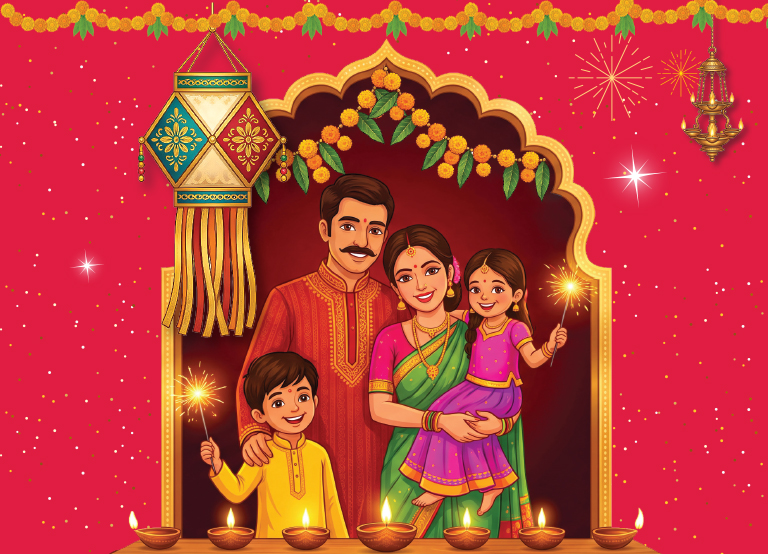
Diwali is a five-day festival, which is celebrated over consecutive days of Dhanteras, Narak Chaturdashi, Diwali, Govardhan Puja or Bali Pratipada and Bhai Dooj. For Jains, Diwali marks the day Lord Mahavir attained nirvana, while Sikhs commemorate the release of Guru Hargobind Singhji from prison on Bandi Chhor Divas, which falls on Diwali day. The same festival can therefore carry different stories, traditions and meanings while being close to all our hearts.
THE FIVE ILLUMINATING DAYS
Day One: Dhanteras
The Diya of Well-being, Renewal and Wealth
Dhanteras is celebrated two days before Diwali. It is associated with wealth, health and protection from untimely death. Prayers are offered to Goddess Lakshmi, the goddess of wealth and prosperity, and to Lord Dhanvantari, the god of health, healing and Ayurveda. Dhanvantari is believed to be an incarnation of Lord Vishnu. Prayers and diyas are also offered to Lord Yama, the god of death, to ward off untimely death. On this day, the rangoli drawn at the entrance of homes often has the goddess’ feet. Diyas are also lit at the entrance to welcome prosperity and good fortune.
Day Two: Narak Chaturdashi or Kali Chaudas
The Diya of Inner Purification
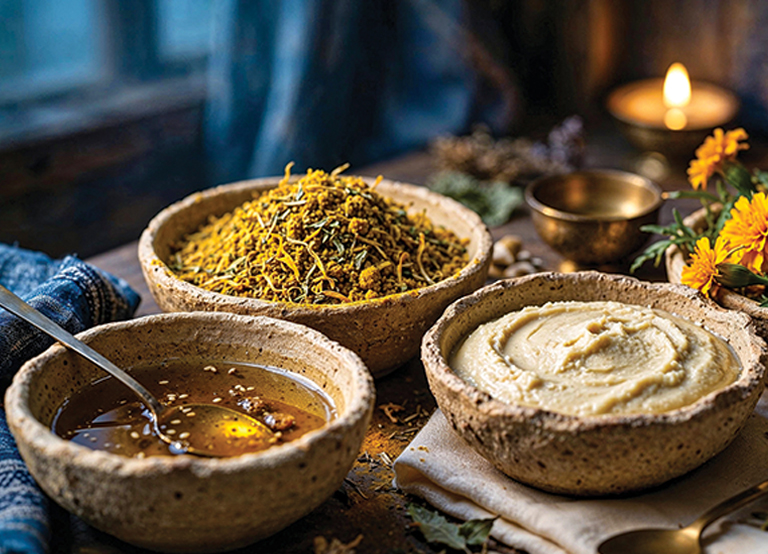
Narak Chaturdashi is associated with cleansing, removing negativity and the triumph of good over evil. In different regions, the day is connected with Lord Krishna and his consort Satyabhama, Goddess Kali and Lord Yama. People who follow this tradition wake up before dawn, apply oil and use a special scrub to bathe. Diyas are lit outside homes in the evening, called Yama Deepam, to appease Yama and invite divine light into their lives.
Day Three: Diwali and Lakshmi Puja
The Diya of Light and Prosperity
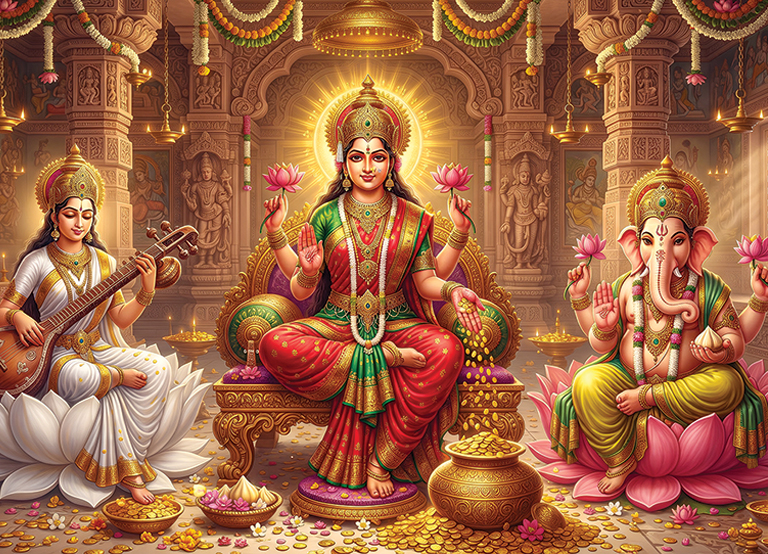
Diwali or Lakshmi Puja is the grand night of celebrations, with prayers, diyas, rangolis, fireworks and sweets—a true Festival of Lights in every sense. Prayers are offered to Lord Ganesh, the remover of obstacles and provider of new beginnings, Goddess Lakshmi and Goddess Saraswati, who is worshipped for knowledge and wisdom. Lord Kuber, the keeper of wealth, is also worshipped to protect wealth and assets.
Day Four: Govardhan Puja and Bali Pratipada
The Diya of Gratitude, Generosity and Abundance
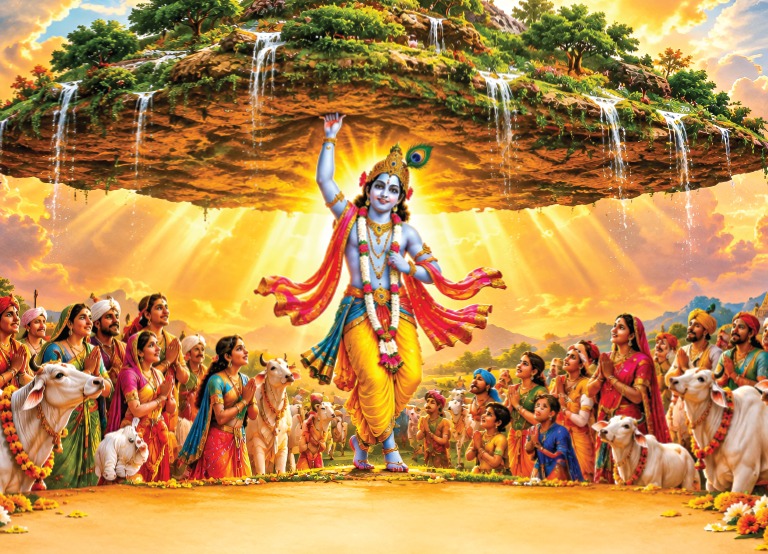
The fourth day is associated with Govardhan Puja in many regions. It is a day when people offer prayers and express gratitude to Lord Krishna for lifting Mount Govardhan to protect the people of Gokul from the wrath of Lord Indra. The occasion is also about expressing gratitude for nature and the food it provides. One of the most spectacular traditions of the day is Annakut, which literally means ‘mountain of food’. 56 vegetarian dishes, including sweets, savouries, vegetables, grains and fruits, are prepared and arranged before Krishna as an offering of abundance and gratitude and to seek blessings for the year ahead. In other regions, Bali Pratipada is observed to honour the generosity and devotion of King Bali.
FOLKLORE
Lord Krishna and Mount Govardhan
Lord Krishna held up Mount Govardhan for seven straight days to save the people of Gokul from the rain god Lord Indra’s wrath. It is believed that he ate eight meals every day. This is why 56 (8×7) different delicacies are served in the Annakut.
Day Five: Bhai Dooj
The Diya of Sibling Bonds
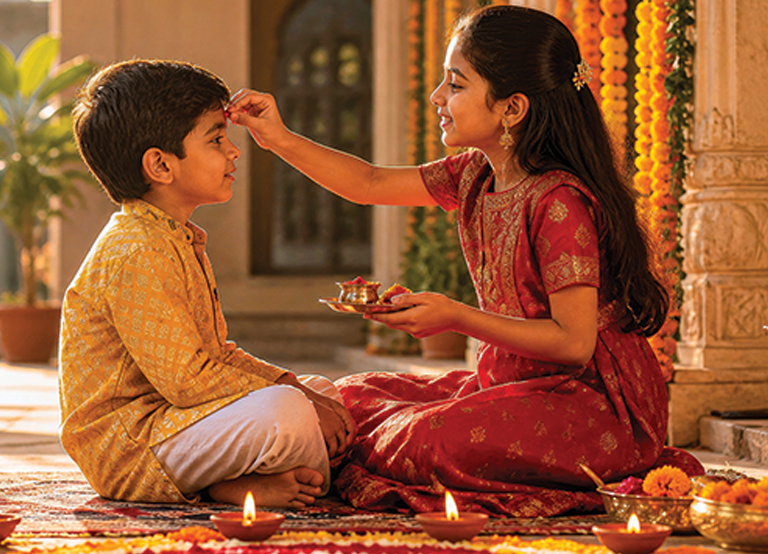
Bhai Dooj is dedicated to siblings and celebrates the bond between brothers and sisters. On this day, sisters perform a prayer ritual by applying a tilak on their brothers’ forehead and praying for their well-being and long life. Brothers, in turn, promise to protect their sisters and be by their side through thick and thin. It is believed that after Lord Krishna defeated the demon Narakasur, he returned to visit his sister Subhadra. Delighted to see her brother return safely, Subhadra welcomed him with sweets and flowers, performed an aarti and applied a tilak on his forehead. She prayed for his well-being and celebrated his victory. This tradition became associated with Bhai Dooj. Interestingly, another more widely associated legend of Bhai Dooj is the story of Lord Yama and his sister Yamuna.
Dev Diwali
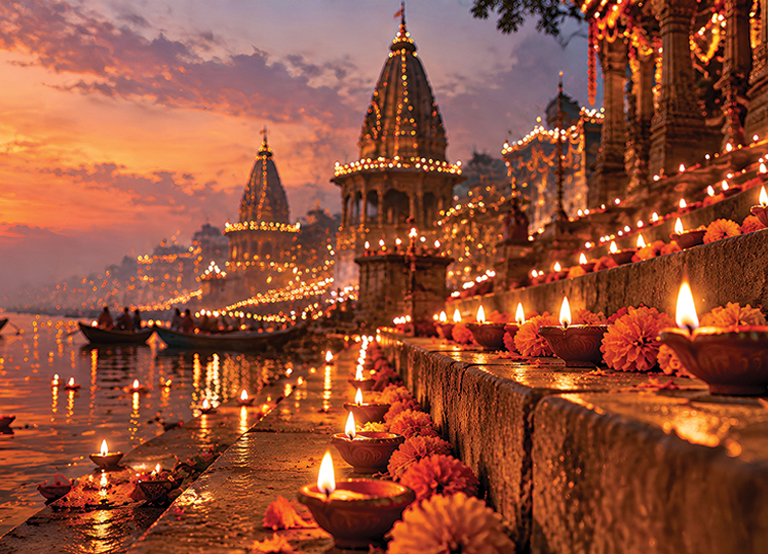
Dev Diwali is primarily celebrated in Varanasi, Uttar Pradesh, 15 days after Diwali. The banks and ghats of the holy Ganga River are adorned with thousands of glowing diyas and colourful rangolis. Diyas light up homes and the entire Ganga ghat is a celebration of the gods, devotion and the victory of good over evil.
FOLKLORE
Lord Shiva and Dev Diwali
According to legend, three demon brothers together known as the Tripurasura received a boon from Lord Brahma. They lived in three powerful floating cities of gold, silver and iron, which could be destroyed only when they aligned—once in a thousand years. When the demons began troubling the three worlds, the gods turned to Lord Shiva. On Kartik Poornima, when the three cities finally aligned, Shiva destroyed them with a single arrow and came to be known as Tripurari. To celebrate his victory, the gods descended to Kashi or Varanasi and lit thousands of diyas along the Ganga, a tradition remembered today as Dev Diwali.
SAME DIYA, DIFFERENT MEANINGS
The story of Diwali changes as we travel across India as each region has its own unique legends and related rituals.
North India
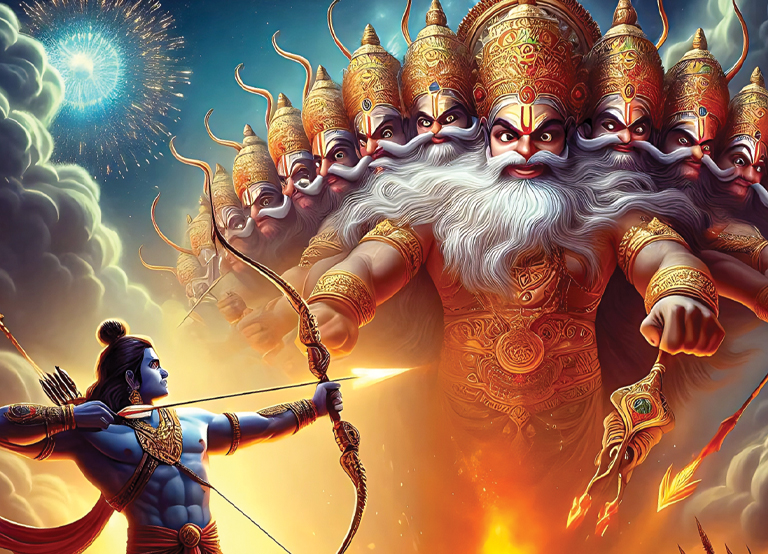
In many parts of North India, Diwali is associated with the return of Lord Ram to Ayodhya after completing his 14-year exile. It is believed that the people of Ayodhya lit diyas to celebrate his return as it was a dark Amavasya (no moon) night. The light of the diyas illuminating the darkness is also seen as a celebration of the path of righteousness and Ram’s victory over demon Ravan.
The celebrations also include worshipping Goddess Lakshmi, lighting firecrackers and playing cards, as it is believed that Goddess Parvati (an avatar of Lakshmi) played dice with Lord Shiva on Diwali night and playing cards on this night is said to bring prosperity throughout the year.
Another famous legend associates Diwali with Samudra Manthan, the churning of the ocean between demons and gods, when Lakshmi and Lord Dhanvantari emerged from the ocean carrying a pot filled with the elixir of life. The day is therefore associated with their emergence and with wealth, health and prosperity. On this day, people shop for jewellery, books and metal utensils as these are considered auspicious items and symbolise growth and prosperity.
Dhanteras often marks the beginning of the festive period. But why are diyas lit on this day?
FOLKLORE
King Hima and Lord Yama
According to a popular legend, King Hima was a fair ruler and loved his son deeply. An astrologer predicted that his son would die on the fourth day of his marriage due to a snakebite. After marriage, his clever daughter-in-law placed innumerable lamps and diyas throughout the house, along with gold and silver coins and jewellery. She also sang melodious songs to keep herself and her husband awake. That night, when Lord Yama arrived as a snake, he was so captivated by the diyas and the songs that he missed the time to take the young prince’s life and the prince was saved.
South India
The day before Diwali is celebrated as Chhoti Diwali or Narak Chaturdashi and is associated with Lord Krishna and Satyabhama. Especially in parts of Andhra Pradesh, a clay idol of Satyabhama is worshipped alongside Krishna
FOLKLORE
King Bali
In Karnataka and several other regions, Bali Pratipada is observed. Bali was a generous king who was known for his legendary oath of never turning away a beggar or saint asking for alms. But he was so powerful that he had conquered all three worlds—Earth, the netherworld (Patal Lok) and heaven.
Lord Indra and other gods prayed for help to Lord Vishnu, who disguised himself as a short, young Brahmin boy, Vamana. During a sacrificial ritual (yajna), he approached King Bali and asked for a piece of land that could be covered by his three steps. Bali happily agreed to his request.
Vamana then grew in size manifold. With one step, he covered Earth; with the second, he covered heaven. For the third step, Bali offered his head, realising that Vamana was Vishnu.
Bali had kept his promise and his generosity greatly impressed Vishnu. Instead of sending him to Patal Lok, Vishnu granted Bali a boon that allowed him to return to Earth and visit his subjects. Since then, Bali is remembered for his devotion and complete surrender to the divine.
West India
In Gujarat, on Dhanteras day, people celebrate Goddess Lakshmi by praying to her in different physical forms—various forms of wealth as well as equipment that helps people earn money, such as computers, gas stoves, arms, machinery and more. Footprints of the goddess are created at the entrance of the house to welcome her. The day before Diwali is also celebrated as Kali Chaudas. On this day, prayers are offered to Goddess Kali or Mahakali and Lord Hanuman to get rid of negativity, chronic sickness and debt. Diwali day is celebrated as Chopda Pujan, where families pray to Lord Ganesh, Lakshmi and Goddess Saraswati for health, wealth and mindfulness. It is on this day that families and businesses enter the first letters into new account books and mark them with auspicious symbols such as the Swastik and Om. Gujarati business families celebrate the day after Diwali as Bestu Varas or New Year. This day marks the first day of the Vikram Samvat calendar. It is a day to begin auspicious activities.
In Maharashtra, Diwali is celebrated over several days. The festivities begin with Vasu Baras, the day before Dhanteras, when cows and calves are worshipped, celebrating motherhood and the bond between a mother and her calf. Diwali is also a time for mouth-watering sweet and savoury feasts, with sweets like karanji and ladoo and snacks such as chakli and sev. This feast is known as faral.
FOLKLORE
Lord Krishna and Narakasur
It is believed that the gods asked Lord Krishna to save the Earth and heaven from the demon Narakasur when he was causing great distress. According to a popular legend, Narakasur had been given a boon that no man could kill him. Satyabhama therefore accompanied Krishna to defeat the demon. After a fierce battle, Satyabhama killed Narakasur and freed thousands of women whom he had imprisoned. The slaying of Narakasur is seen as the removal of darkness and the arrival of light. Therefore, the day has a deep symbolic meaning. On Narak Chaturdashi day, some Maharashtrian families crush a bitter fruit called karit under their foot. The fruit is associated with the head of the defeated demon Narakasur and crushing it symbolically represents the victory of good over evil.
Goa has an especially dramatic Narakasur tradition. Large effigies of the demon are made and displayed and then burnt early on the morning of Narak Chaturdashi, commemorating Krishna’s defeat of Narakasur.
East India
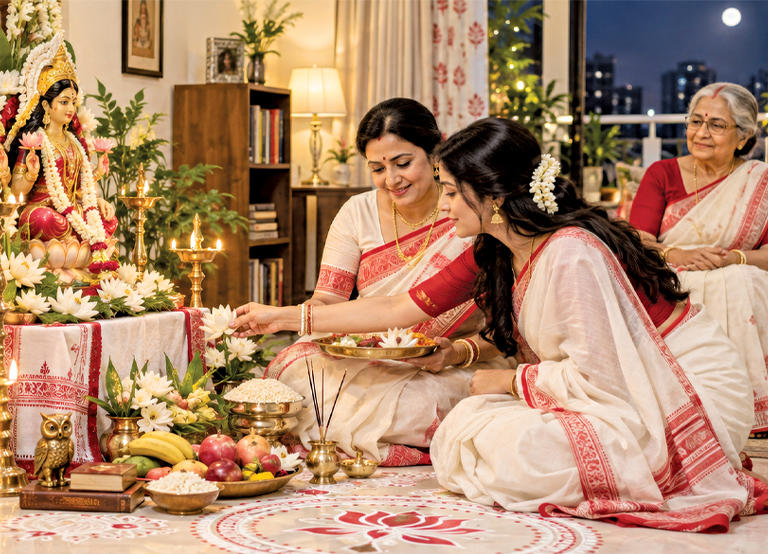
In eastern India, especially in West Bengal, Odisha and Assam, Diwali rituals include worshipping Goddess Kali along with Goddess Lakshmi with flowers, sweets, bhog and diyas.
Bengalis also observe Lakshmi Puja five days after Vijayadashami or Dussehra. This celebration is known as Kojagori Lokkhi Pujo and is also observed in Assam and Odisha. Lakshmi Puja is performed in the evening and Kali Puja is performed late at night and continues until the early morning hours.
In Odisha, people also pay tribute to their ancestors on this day by burning jute sticks and seeking their blessings.
FOLKLORE
Goddess Kali and Raktabija
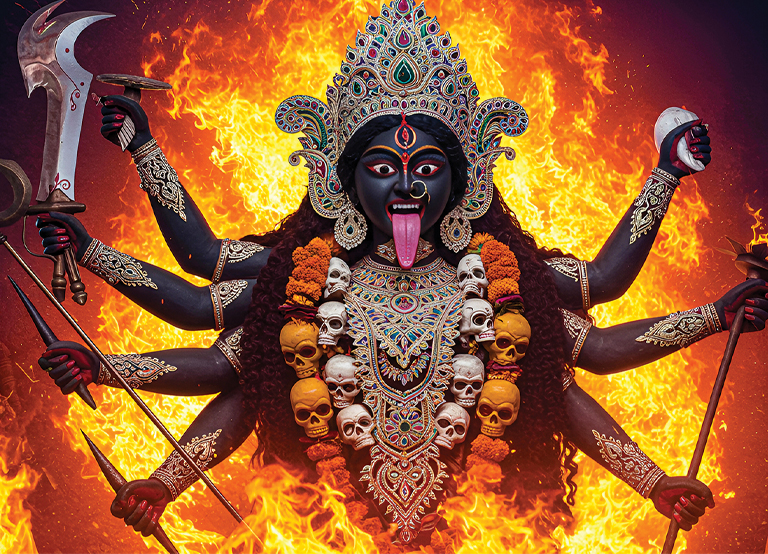
Goddess Kali is considered as the fierce form of Shakti, the one who destroys all evil forces. According to a popular legend, Kali killed the demon Raktabija, who would multiply himself with every drop of his blood that fell on the ground. Each drop of blood worked as a seed, giving birth to similar demons. The goddess widened her mouth and consumed every droplet of his blood to stop the demons from multiplying. She eventually killed him and restored peace. The legend can also be seen as a reminder to overcome our own internal evils like jealousy, greed and anger. If left unchecked, they tend to multiply and harm us.
FOLKLORE
Goddess Kali and Lord Shiva
According to legend, two powerful demons, Shumbha and Nishumbha, had wrongfully captured heaven. Goddess Kali emerged and not only killed the two demons, but also slew their huge army. In the ecstatic frenzy of destruction, she was unstoppable, threatening the whole planet. To save the universe, Lord Shiva obstructed her path by lying down on the ground. The moment she stepped on him, she realised her mistake and bit her tongue in extreme shock. That broke her state of destructive trance. Both episodes are considered divine—one ended the demonic reign and the other restored peace. Therefore, many people celebrate this specific moment of universal relief and maternal protection of Kali, as she is believed to remove ego and negativity. It is the victory of love over anger.
THE ESSENTIALS OF DIWALI
While the stories and rituals of Diwali differ across India, certain sights, sounds and flavours have become closely associated with the festival. Each has a story and significance of its own.
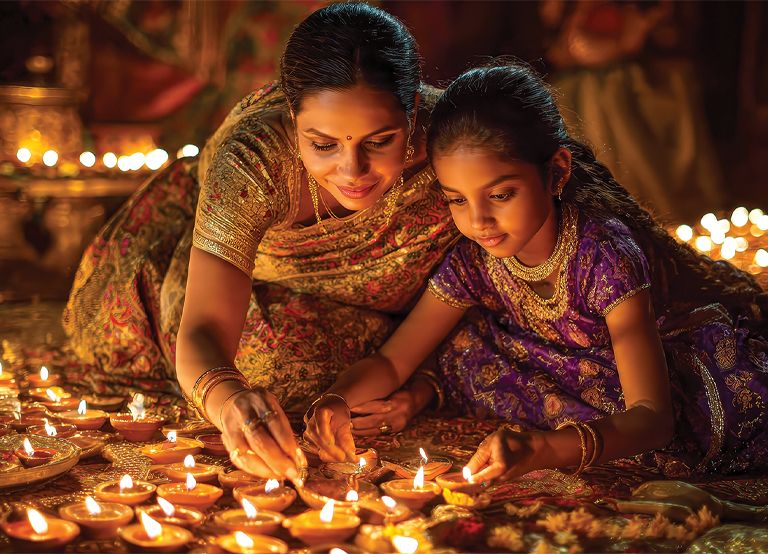
- Diyas: Dispelling Darkness
Small clay lamps called diyas are traditionally filled with oil or ghee, fitted with a cotton wick and lit inside and outside homes. Light represents knowledge, goodness and hope, while darkness is associated with ignorance and negativity. Lighting diyas therefore symbolises the victory of light over darkness and good over evil. In many traditions, rows of diyas are also placed at entrances to welcome Goddess Lakshmi, who is associated with prosperity and good fortune. - Torans: An Auspicious Doorway
Torans are traditionally hung above the entrance of a home and are often made from marigold flowers and mango or asoka leaves. These plants have a symbolic significance—the bright yellow and orange of marigolds are associated with the sun, positivity and auspicious occasions, while their ability to remain fresh for relatively long periods makes them well suited to festive decorations. Evergreen leaves such as mango and asoka traditionally represent life, fertility, prosperity and well-being. Together, they transform the doorway into an auspicious entrance that welcomes guests, good fortune and Goddess Lakshmi.
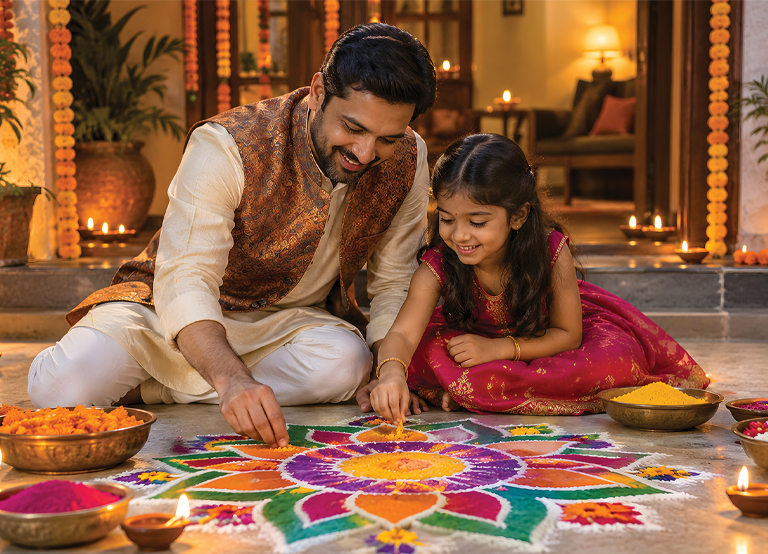
- Rangoli: Welcoming ProsperityColourful rangolis are created on the floor, particularly near entrances and prayer areas, using rice flour, coloured powders, flower petals and other materials. The entrance of a home is traditionally considered an important space through which guests, blessings and prosperity are welcomed. During Diwali, rangolis often feature auspicious symbols such as lotus flowers and diyas. Tiny footprints representing Goddess Lakshmi may also be drawn leading into the home, symbolically inviting her to enter and bring prosperity.
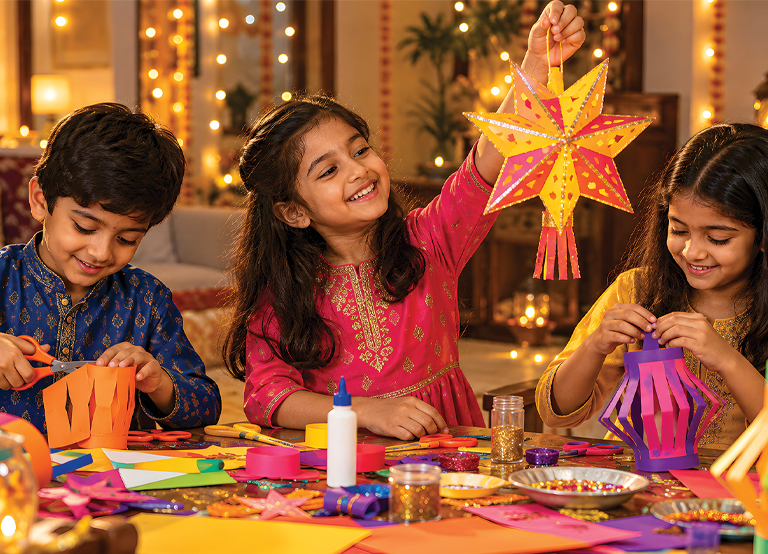
- Akash Kandils: Light Above the Door
Colourful akash kandils, literally meaning ‘sky lanterns’, are hung outside homes during Diwali. Their light continues the central theme of the festival—dispelling darkness and welcoming hope and positivity. Traditionally displayed at entrances and balconies, they also illuminate the way to the home and signal that the household is celebrating Diwali. - Cleaning the Home: Making Way for the New
In the days leading up to Diwali, families traditionally clean, declutter, paint and decorate their homes. This has both a practical and symbolic purpose. In many traditions, Goddess Lakshmi is believed to visit clean, well-lit and welcoming homes. Clearing away dirt and unwanted belongings also represents leaving behind the old and making space for positivity, prosperity and a fresh beginning.
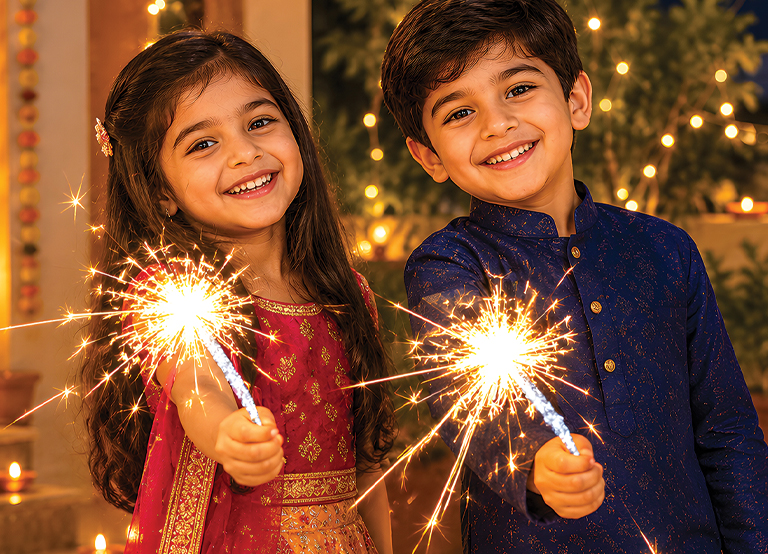
- Fireworks: Bursts of Celebration
Fireworks became associated with Diwali much later and are not part of its ancient origins. Today, awareness of air pollution, noise pollution and the effects of loud fireworks on people and animals has encouraged many families to celebrate with fewer or no firecrackers.
- Mithai: Sharing Something Sweet
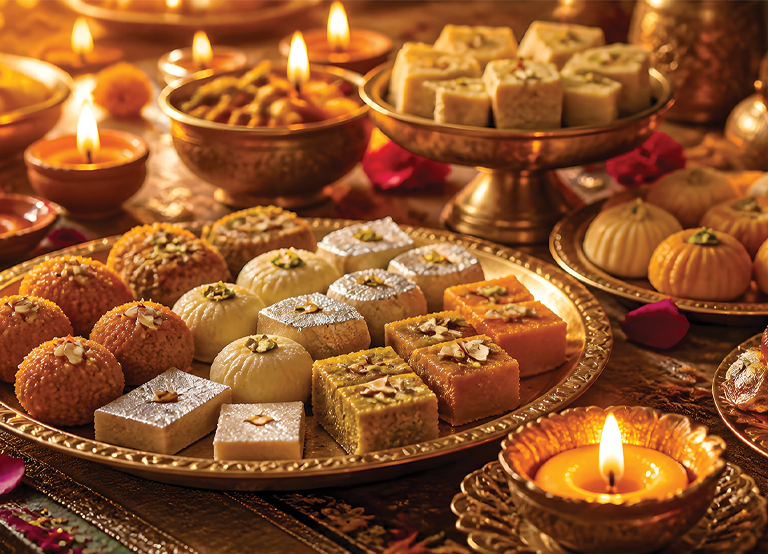
Sweets are prepared or bought for Diwali, offered to deities during prayers and then shared with family, friends, neighbours and visitors. In Indian tradition, sweet foods are closely associated with auspicious occasions, happiness and new beginnings. Offering someone mithai is therefore a way of sharing the joy and good fortune of the festival. The sweets themselves differ across India, from laddoos and barfi to kaju katli, karanji and many regional specialities. - New Clothes: A Fresh Beginning
Wearing new clothes during Diwali reflects the festival’s theme of renewal. Just as homes are cleaned and decorated, dressing in something new symbolises leaving the old behind and beginning afresh. New clothes are also traditionally worn for pujas, family gatherings and visits to relatives, adding to the sense that Diwali marks an auspicious new beginning.
- Gifts: Sharing Good Fortune
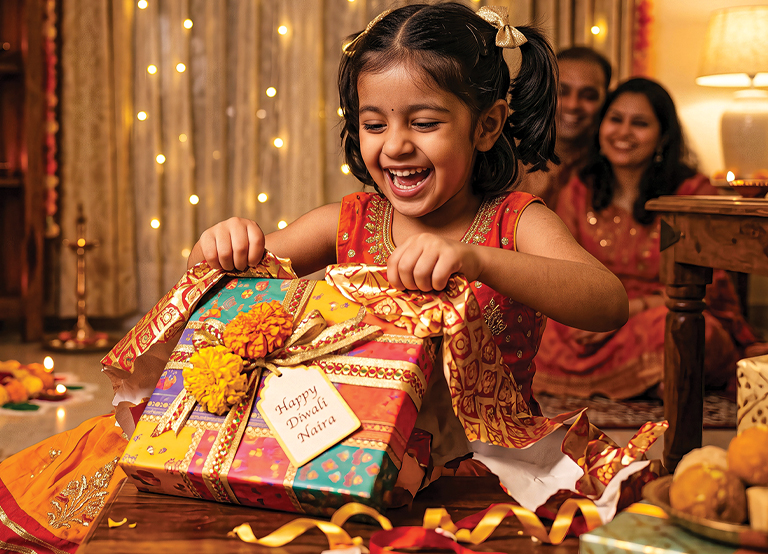
Exchanging sweets, dry fruits and gifts is a way of sharing prosperity rather than keeping it to oneself. Visiting relatives, friends and neighbours with something to offer also strengthens relationships and turns Diwali from a celebration within one home into a celebration shared with the wider community.
THE WORLD CELEBRATES
Over centuries, Indian traders, travellers and later migrant and diaspora communities carried with them a piece of India in the form of culture, traditions, stories and celebrations. And when these reached a new place, they blended with local traditions and became part of the local culture too. The journey was not the same everywhere.
Nepal Celebrates Diwali to Honour Nature, Animals and Ancestors
Tihar or Yamapanchak is a five-day festival celebrated in Nepal and shares several traditions with Diwali. It has its own cultural identity and sequence. The celebrations are about expressing gratitude to deities, nature, flora and fauna, including animals and birds, over five days.
- Day one is celebrated as Kaag Tihar. On this day, sweets, rice and curd are offered to crows, which are considered messengers of Lord Yama. It is also a way of expressing gratitude to ances tors, seeking their blessings and removing any bad omens.
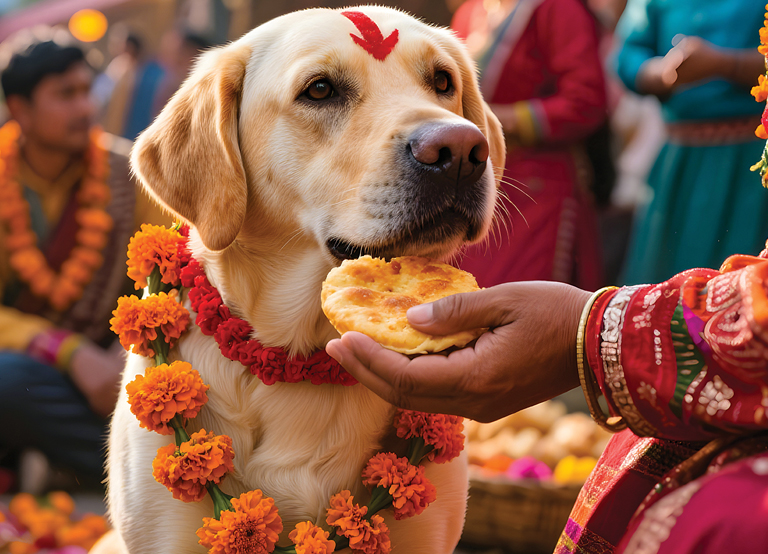
- Day two is celebrated as Kukur Tihar. On this day, dogs are worshipped and offered food to celebrate their loyalty.
- Day three is celebrated as Gai Tihar when cows are worshipped. On the same evening, Lakshmi Puja is also performed and people sing folk songs.
- Day four is celebrated as Goru Puja when people express gratitude to oxen and bullocks for their agricultural work. Some communities also believe in self-worship, a ritual that involves self purification and worshipping one’s own soul.
- Day five is observed as Bhai Tika, when sisters apply tika to their brothers and pray for their well-being and longevity. The event is quite similar to Bhai Dooj.
Southeast Asia and the Rest of the World
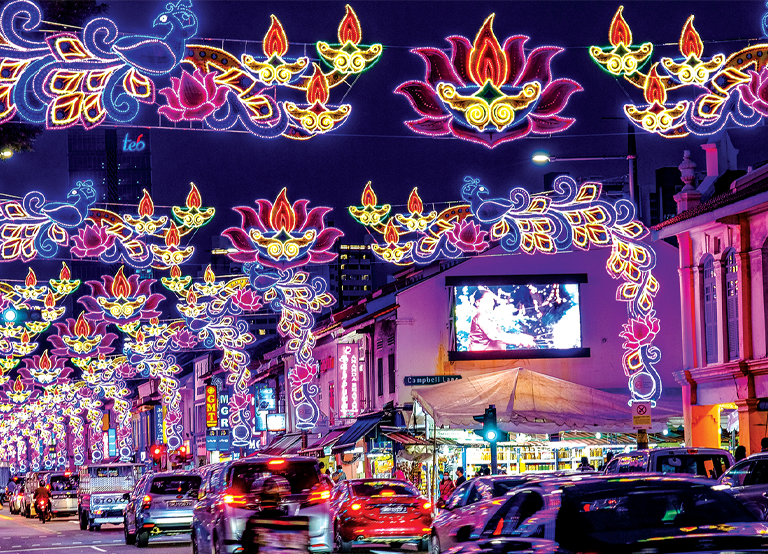
In Malaysia, Singapore, Mauritius, Fiji and Trinidad and Tobago, Diwali is marked with lights, decorations, busy markets and cultural festivities. In Bali, Hindu traditions include temple prayers, local feasts and candle-lit offerings. Across the UK, USA, Canada, Australia, South Africa, the UAE and other parts of the world, Indian communities have carried Diwali traditions with them. People light rows of diyas, prepare traditional sweets and savouries, visit one another and gather with family and friends. That’s how traditions are passed on from one generation to another.
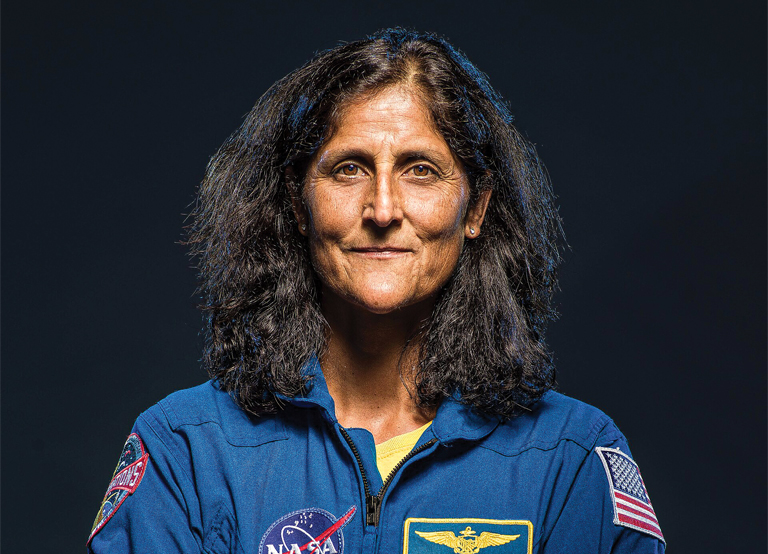
Diwali is no longer celebrated only in India. Its glow can be seen across the world—and even 260 miles above our planet, Earth.
“Greetings from the International Space Station (ISS), I am NASA Astronaut Sunita Williams, and I want to extend my warmest wishes for a Happy Diwali to everyone celebrating the festival of lights today…”
— this heartfelt message was sent by Indian origin astronaut Sunita Williams and played at the White House Diwali reception hosted by US President Joe Biden in October 2024. It was a moment of great joy when President Biden lit a diya at the White House that same night.